
The damage is already there on the day
The most common thing we hear from a bride bringing in a gown three years after the wedding is that it looked perfectly clean when she put it away. It probably did. That is exactly the problem.
Champagne, white wine, cake icing, sweet tea and clear soda all leave sugar behind. Perspiration leaves salts and proteins. On the day, none of these are visible on ivory silk. Over months and years they oxidise — the same chemical process that turns a cut apple brown — and emerge as yellow-brown blooms, most often at the hem, the underarms, the neckline and anywhere a glass was held.
This is why timing matters more than any other decision. A gown cleaned within a few weeks of the wedding comes out fundamentally different from an identical gown cleaned after three years in a closet. Fresh sugar dissolves readily. Oxidised sugar has chemically bonded to the fibre, and at that point the honest answer is that some of it may be permanent.
What 'preservation' actually means
Preservation is not a cleaning method. It is what happens after cleaning, and it comes down to one thing: the absence of acid.
Ordinary cardboard, standard tissue paper and most garment boxes are acidic. They off-gas slowly and that acidity migrates into fabric, causing exactly the yellowing that preservation is supposed to prevent. Storing a cleaned gown in an ordinary box is actively harmful — the box itself becomes the cause of the damage.
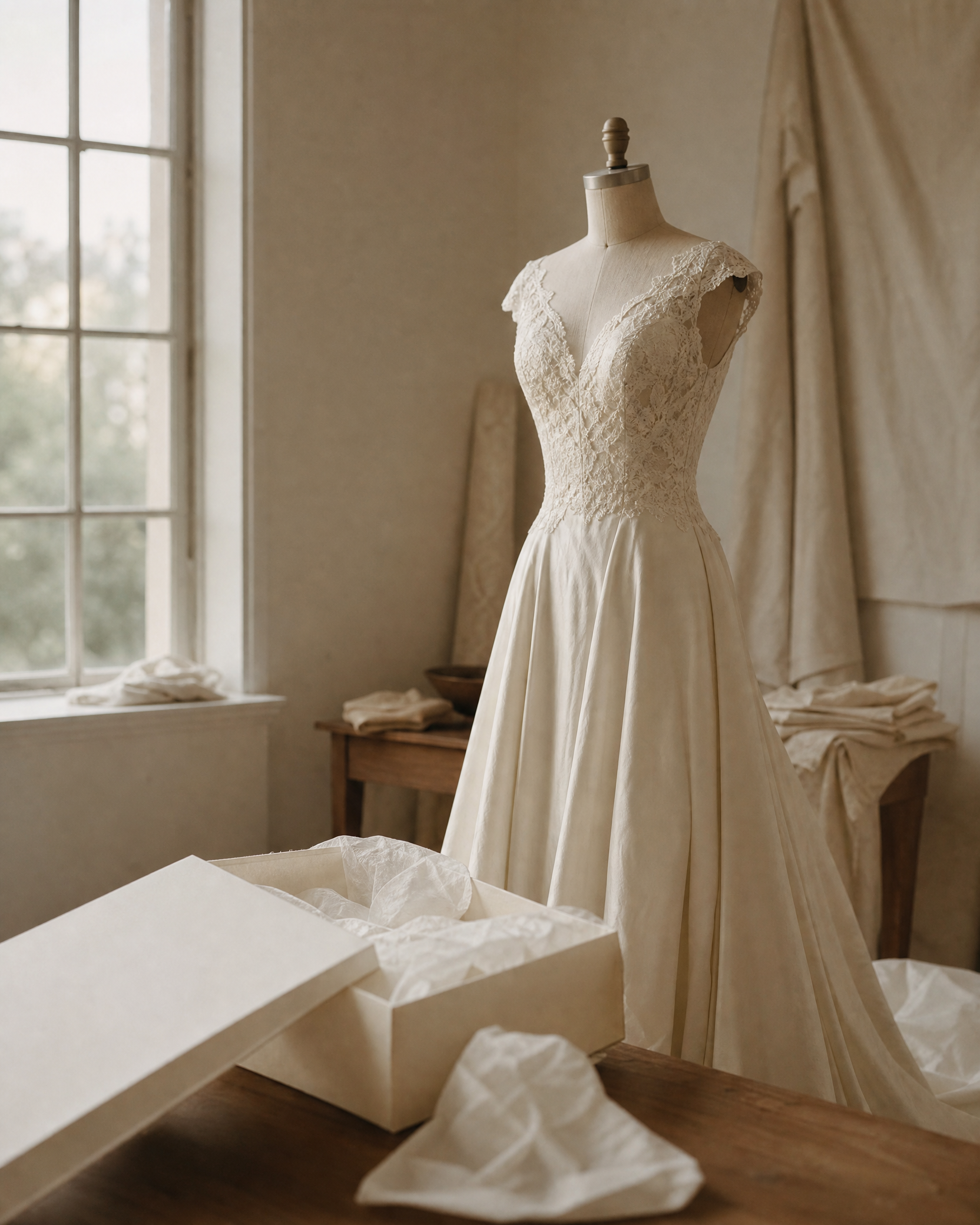
Genuine archival preservation means a museum-quality acid-free box, buffered acid-free tissue supporting every single fold so the fabric never creases against itself under its own weight, and no plastic anywhere. Plastic garment bags are the worst option of all: they trap residual moisture against the fabric and can off-gas into it, which produces both yellowing and, in humid climates, mildew.
Timing beats technique — get the gown cleaned within weeks, not years.
Why gowns need garment-by-garment judgment
A single wedding dress is rarely one fabric. A typical gown combines a silk or polyester shell, a tulle or organza overlay, a horsehair-stiffened hem, glued or hand-sewn beadwork, sequins, lace appliqué and an internal corset with boning. Each of those components tolerates a different treatment, and some of them tolerate very little.
The practical consequence is that a gown has to be cleaned according to whatever its most fragile component can survive, not according to what its main fabric could handle. Glued beadwork in particular will not survive a process that plain silk charmeuse would shrug off. This is why gown work is inspected bead by bead before anything begins, and why the hem and underarms — which carry the heaviest soil — are usually treated by hand.
How to store the box once you have it
Keep it flat, and keep it inside the house. That is most of it.
Flat matters because a gown standing or hanging carries its own weight on a few seam points for years, and fabric under sustained tension distorts permanently. Inside the house matters because attics, basements, garages and storage units all swing dramatically in temperature and humidity, and it is that cycling — expansion, contraction, condensation — that degrades fibres and grows mildew. A closet shelf in a climate-controlled part of the house is genuinely the best place.
If you want to be thorough: every couple of years, wash your hands, open the box, and refold the gown along slightly different lines. Any fold left in place indefinitely eventually becomes a permanent crease with weakened fibres along it. Handle it as little as possible otherwise — skin oils are exactly what you spent money removing.
If your gown has already yellowed
Bring it in anyway. Restoration on an older gown is real work with genuinely uncertain outcomes, but the range of outcomes is wide and worth exploring before you write the dress off.
What we can tell you honestly is what we see on inspection: whether the discoloration is surface soil that will lift, oxidised sugar that may partially lift, or fibre damage that will not. We would rather tell you a gown cannot be fully restored before you pay for the attempt than after. And if it is a mother's or grandmother's gown that someone hopes to wear, that conversation should happen well before a wedding date, not the month before.
Written by the staff of FabriCare of Greenville, a family-owned dry cleaner with three stores and its own plant in Greenville County, South Carolina. Our spotters and pressers are trained in-house, and the advice here reflects what we see across the counter every week rather than what reads well online. If you have a garment you are unsure about, call the store nearest you — inspection is free and we will tell you honestly what is possible.